

A play about an economist? Hmm.
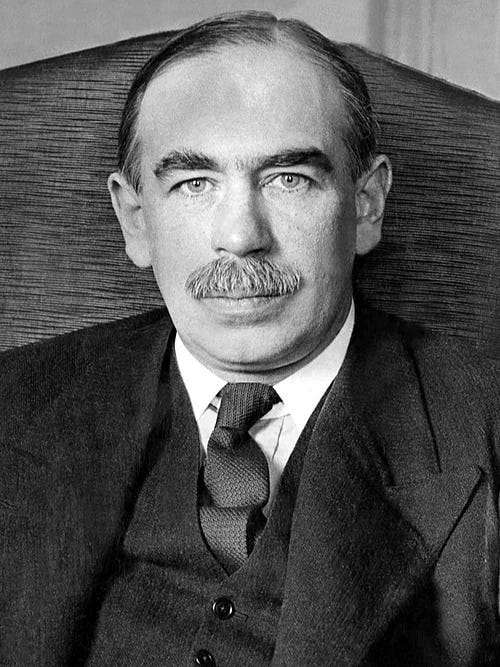
But this is no ordinary economist. This is John Maynard Keynes, philosopher, writer, aesthete, civil servant, the man who created the Arts Council. A member of the Bloomsbury Set, openly homosexual before becoming happily married – his ex lover, artist Duncan Grant, was best man at his wedding – and most importantly, an ethical, decent and generous man.
And this is no ordinary playwright. This is James Graham, the young, astonishingly talented and prolific writer who specialises in making good people interesting, from the 1970s parliamentary whips in This House to Gareth Southgate in Dear England and the protagonists of Punch, a play about forgiveness. Add to the mix the genius director that is Nicholas Hytner, ex Artistic Director of the National Theatre and creator of the Bridge Theatre, and expectations are sky high.
I learned quite a lot about John Maynard Keynes while I was writing my book Exits and Entrances and I more or less fell in love with him then. (He makes a guest appearance in my novel The Purpose of Prudence de Vere.) He is one of the heroes of British theatre, the man who believed in ‘a good life’, which didn’t just mean people were better off but that art, music and theatre were essential to it.
Government funding of public services such as health, education and – most crucially in this case – the arts, are part and parcel of our lives now in the UK, but it wasn’t always the case. For this we partly have Keynes to thank.
His Theory, broadly speaking and as the play presents it, states that spending, not saving, leads to growth and full employment, especially in times of financial strife. The theory was not popular. When at the beginning of World War I he suggested to the British Treasury that they buy a stack of Degas paintings as they would provide a great investment for the future he was laughed at. He was accused of being a Socialist (shock horror). It wasn’t until World War II that his theory came into its own.
The Standard of Living captures everything about this clever, complex man, whose sole aim was to provide for ‘a good life’ for everyone. Yes there are a lot of words, but Graham and Hytner are canny enough to convey the essence of Keynes and his philosophy in a comprehensible, absorbing way. Woven into the action are excerpts of ballet, and onto the moving panels of the set are projected images of the Bloomsbury paintings and of the two World Wars that provide the background to the play. The cast of fifteen includes famous Bloomsberries such as Virginia Woolf and her sister Vanessa Bell, Bell’s husband Clive, Lytton Strachey – an ex of Keynes’s – and his lover Carrington, as well as Duncan Bell. I was particularly captivated by the professional rivalry between Keynes and the Austrian economist Friedrich Hayak, whose childish claims that ‘my book sold better than yours’ are underpinned by a deep mutual respect.


It’s not the most easy-going evening spent in the theatre. Full concentration is required. Rory Kinnear plays Keynes with total authority and holds the entire evening together, and the Russian ballerina Natalia Osipova plays his Russian ballerina wife Lydia Lopokova with great animation and verve (in her first acting role).
How astonishingly lucky we are in the UK not just to have produced a genius like John Maynard Keynes but to have people with the courage, the creativity and the wisdom to put him on a stage. Economics students could learn a lot from this play. It is entirely fitting that Keynes’ conviction that arts play a crucial part in a good life is so deftly illustrated on stage at the Theatre Royal Haymarket. (And the theatre was packed last night.)